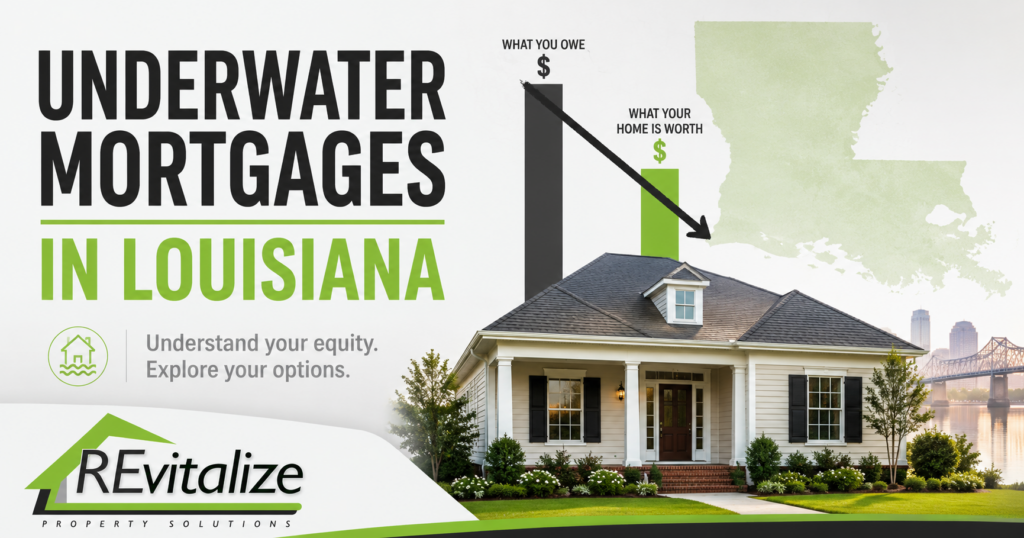
Louisiana homeowners are considerably more likely to be underwater on their mortgages than homeowners across most of the country.
According to ATTOM’s second-quarter 2026 U.S. Home Equity & Underwater Report, 10.3% of mortgaged residential properties in Louisiana were seriously underwater, compared with just 3.2% nationally. Louisiana had the second-highest seriously underwater rate in the country.
But what does being “underwater” actually mean?
Simply put, an underwater mortgage occurs when a homeowner owes more against a property than the property is currently worth. This is also known as having negative equity.
Understanding that distinction is important, particularly in Louisiana, where homeowners currently have substantially less equity than homeowners nationally.
In this article, we’ll explain what these numbers mean, why some Louisiana homeowners find themselves underwater, and what options may be available if you owe more than your home is worth.
What Does It Mean to Be “Seriously Underwater”?
A homeowner is generally considered underwater on a mortgage when the total amount owed against the property exceeds its current market value. This is also known as having negative equity.
ATTOM uses a more specific threshold when it classifies a property as seriously underwater. Under ATTOM’s methodology, the combined estimated balances of loans secured by the property must be at least 25% greater than the property’s estimated market value.
For example, suppose a home is currently worth $200,000.
If the homeowner owes $210,000, the property has negative equity, but it would not meet ATTOM’s definition of seriously underwater.
If the homeowner owes $250,000 or more, it would.
That distinction is important. The statistic showing that 10.3% of mortgaged Louisiana properties are seriously underwater does not mean those are the only Louisiana homeowners with negative equity. It represents homeowners whose estimated mortgage debt exceeds ATTOM’s estimated property value by a particularly significant amount.
It also doesn’t tell us whether those homeowners are behind on their mortgage payments or experiencing financial hardship. Equity and mortgage-payment status are separate issues.
Louisiana Homeowners Have Much Less Equity Than the National Average
The percentage of seriously underwater properties tells only part of the story.
ATTOM also tracks properties it considers equity-rich, meaning the combined estimated balances of loans secured by the property are no more than 50% of the property’s estimated market value.
Nationally, 41.1% of mortgaged residential properties were equity-rich in the second quarter of 2026.
In Louisiana, only 17.5% were.
Put another way, more than four out of every ten mortgaged homes nationally were equity-rich, compared with fewer than two out of ten in Louisiana.
The numbers are similarly weak in South Louisiana.
Among the large metropolitan areas analyzed by ATTOM:
- New Orleans: 19.9% equity-rich and 8.5% seriously underwater
- Baton Rouge: 15.4% equity-rich and 10.9% seriously underwater
These numbers don’t mean that most Louisiana homeowners have negative equity. There is a substantial middle ground between being seriously underwater and being equity-rich.
What they do show is that Louisiana homeowners, as a group, have substantially smaller equity positions than homeowners nationally. That can leave some property owners with less financial flexibility when they need to sell, refinance, relocate, or deal with an unexpected financial hardship.
There is some encouraging news. Louisiana’s seriously underwater rate declined from 11.9% in the second quarter of 2025 to 10.3% in the second quarter of 2026.
So the data do not indicate that Louisiana is suddenly experiencing a wave of mortgage distress. Instead, they point to a broader vulnerability: Louisiana has an unusually high percentage of seriously underwater properties while simultaneously having an unusually low percentage of equity-rich properties.
Why Are Some Louisiana Homeowners Underwater?
There is no single reason why a homeowner ends up owing more than a property is worth.
Home equity is primarily determined by two things: how much is owed against the property and what the property is currently worth.
A homeowner who purchases a property with a small down payment begins with relatively little equity. During the early years of a typical mortgage, a larger portion of each payment also goes toward interest rather than principal, so the loan balance may decline relatively slowly.
If property values rise during that period, appreciation can help build equity. But if values remain stagnant or decline, a recent buyer may have very little cushion.
That is particularly relevant in parts of Louisiana’s current housing market.
In the New Orleans-Metairie market, for example, Realtor.com reported that the median asking price in July 2026 was 6.5% lower than one year earlier, while homes were taking a median of 79 days to sell, compared with 57 days nationally.
Those figures don’t mean every property in Greater New Orleans has declined by 6.5%. Real estate conditions can vary substantially by parish, neighborhood, property type, condition and price range. But they do indicate a market where homeowners cannot necessarily depend on rapid appreciation to build equity.
Insurance and Affordability Also Affect the Market
Louisiana’s property-insurance challenges add another layer.
Higher insurance premiums do not directly reduce a homeowner’s equity. A home’s equity is determined by its value relative to the debt secured by it.
But insurance affects what it costs to own the property.
For many buyers, the important affordability number isn’t simply the purchase price or mortgage principal and interest. It is the total monthly housing payment, including principal, interest, property taxes and homeowners insurance.
When insurance consumes a larger portion of that monthly budget, a buyer may have less purchasing power available for the house itself. That can affect demand and, ultimately, the prices sellers are able to obtain.
Timing Matters
Consider two homeowners who own otherwise similar properties.
One purchased years ago, made a substantial down payment and benefited from years of mortgage principal reduction and property appreciation.
The other purchased more recently near a higher market value, financed most of the purchase price and has had relatively little time to reduce the mortgage balance.
A modest decline in value may have little effect on the first homeowner’s ability to sell.
The same decline could put the second homeowner underwater.
That’s one reason statewide statistics need to be interpreted carefully. Being underwater is ultimately a property-specific financial situation, not simply a condition of the overall housing market.
Being Underwater Does Not Mean You Are in Foreclosure
A homeowner can owe more than a property is worth while remaining completely current on the mortgage.
If you can comfortably make your payments and have no reason to sell, being underwater may create no immediate problem at all. Your mortgage payment does not increase simply because the property’s market value declines, and negative equity by itself does not trigger foreclosure.
The situation becomes more important when circumstances change.
A homeowner may need or want to sell because of a job relocation, divorce or separation, loss of income, rising housing expenses, an inherited property, major repairs, changing family circumstances, or another financial hardship.
At that point, negative equity can limit the homeowner’s choices because selling the property may not generate enough money to pay the mortgage and other costs associated with the sale.
Discovering that you’re underwater shouldn’t automatically create panic. It should trigger a closer look at the numbers and your circumstances.
Start With Two Numbers: What Is the Property Worth and What Do You Owe?
If you think you may owe more than your home is worth, don’t start by assuming you’re underwater.
Start by getting accurate information.
You need to determine two basic numbers:
1. What could the property realistically sell for in today’s market?
2. How much would it take to pay off the mortgage and any other debt or liens secured by the property?
Determine a Realistic Market Value
Online home-value estimates can provide a rough starting point, but they should not be treated as a definitive indication of what a property will actually sell for.
Real estate values can vary significantly based on location, condition, renovations, deferred maintenance, flood zone, insurance considerations, comparable sales and current competition from other properties on the market.
A local real estate professional can prepare a comparative market analysis (CMA) using recent sales and current market conditions. In some situations, obtaining an independent appraisal may also be appropriate.
The important number isn’t what the property was once worth, what you paid for it, or what an online estimate says.
It’s what a buyer is reasonably likely to pay for it in today’s market.
Obtain an Accurate Mortgage Payoff
Next, determine exactly what is owed.
The principal balance shown on a mortgage statement is not necessarily the same as the amount required to satisfy the loan at closing.
A mortgage payoff statement may include accrued interest and other amounts due through a specified date.
Homeowners should also identify any additional mortgages, home-equity loans, HELOCs, judgments, tax liens or other claims against the property that could affect the amount necessary to transfer clear title.
Don’t Forget the Cost of Selling
Suppose a home could realistically sell for $250,000 and the mortgage payoff is $245,000.
At first glance, it appears that the homeowner has $5,000 in equity.
But that doesn’t necessarily mean the homeowner can sell without bringing money to closing.
Depending on the transaction, there may also be real estate commissions, closing costs, property taxes, seller concessions, repairs, lien payoffs or other expenses.
What matters is the homeowner’s estimated net proceeds after all debts and transaction expenses are accounted for.
Once those numbers are reasonably established, you can determine whether a conventional sale is financially feasible or whether another solution needs to be considered.
What Are Your Options If You Owe More Than Your Home Is Worth?
The appropriate course of action depends on how far underwater the property is, whether the mortgage is current, whether the homeowner needs to move, whether foreclosure has begun, and the homeowner’s financial circumstances.
1. Keep the Property
If you can afford the mortgage payments and don’t need to move, selling may not be necessary.
Continued mortgage payments can gradually reduce the loan balance, and property values may increase over time, although future appreciation is never guaranteed.
For someone who is only moderately underwater and otherwise comfortable owning the property, time may be the simplest solution.
2. Sell and Bring Money to Closing
If the expected sale proceeds fall only slightly short of what is needed to satisfy the mortgage and selling expenses, the homeowner may be able to cover the difference at closing.
For someone who needs to relocate and can afford the deficiency, this may be preferable to remaining in a property they no longer want or need.
3. Pursue a Short Sale
If the property cannot be sold for enough to satisfy the mortgage, a short sale may be an option.
In a short sale, the mortgage holder agrees to allow the property to be sold for less than the amount owed.
A homeowner cannot simply decide to sell the property short. The mortgage holder and other necessary parties must approve the transaction, and the homeowner may be required to submit financial and other documentation.
Homeowners should also determine how any remaining deficiency will be handled. Approval to sell the property does not necessarily mean every remaining financial obligation has automatically been forgiven.
Short sales can take longer and involve more uncertainty than conventional transactions, so they should be evaluated carefully.
4. Ask the Mortgage Servicer About Loss-Mitigation Options
If the primary problem is difficulty making the mortgage payment rather than a need to sell, there may be alternatives that allow the homeowner to remain in the property.
Depending on the loan and circumstances, these could include repayment plans, forbearance, loan modifications, or other lender-specific loss-mitigation programs.
Availability and eligibility vary, so homeowners experiencing difficulty making payments should contact their mortgage servicer directly.
5. Consider a Deed in Lieu of Foreclosure
In certain circumstances, a lender may agree to accept ownership of the property rather than completing the foreclosure process. This is generally known as a deed in lieu of foreclosure.
It isn’t available in every situation, and homeowners should understand how the lender intends to treat any remaining deficiency and whether other liens against the property affect eligibility.
6. If Foreclosure Has Already Begun, Time Matters
A foreclosure filing does not necessarily mean every other option has disappeared.
But once foreclosure proceedings are underway, deadlines become extremely important, and available options may narrow as the process progresses.
Homeowners in this situation should promptly communicate with their mortgage servicer and consider obtaining assistance from a HUD-approved housing counselor and, when appropriate, a qualified attorney.
Ignoring legitimate foreclosure notices can make an already difficult situation considerably worse.
Can You Sell an Underwater Property to a Cash Buyer?
Yes, but whether it actually solves the homeowner’s problem depends on the numbers.
Cash buyers and real estate investors typically purchase properties based on their current condition and the economics of owning, repairing, renting or reselling them. Because of that, an investor generally cannot pay the same price that might be achievable by exposing a property to the full retail market.
For homeowners with substantial equity, accepting a lower price can sometimes be a reasonable tradeoff for benefits such as selling as-is, avoiding repairs and showings, or completing a transaction more quickly.
Negative equity changes that calculation.
If a homeowner already owes close to, or more than, the property’s full market value, accepting an investor’s discounted purchase price may create an even larger gap between the sale proceeds and the amount necessary to satisfy the mortgage.
A cash buyer cannot make mortgage debt disappear.
That doesn’t mean an investor purchase is never possible when a property is underwater. A lender-approved short sale, for example, could potentially involve an investor or cash buyer. But the necessary parties would still have to approve accepting less than the amount owed.
Sometimes Maximizing the Sale Price Is More Important Than Selling Quickly
Suppose a property might sell for $200,000 on the open market but an investor can reasonably pay only $150,000 because the property requires substantial repairs.
If the homeowner owes $120,000, an as-is investor sale might still be worth considering.
If the homeowner owes $195,000, sacrificing $50,000 of potential sale price could make the homeowner’s financial problem considerably worse.
In that situation, maximizing the property’s exposure and sale price may be much more important than obtaining a fast cash offer.
How REvitalize Property Solutions Approaches These Situations
At REvitalize Property Solutions, we don’t believe every property problem has the same solution.
An as-is purchase may make sense for some homeowners, particularly when a property needs substantial repairs or the owner’s priorities favor convenience and certainty over obtaining the highest possible sale price.
For other homeowners, selling on the open market may produce a substantially better financial outcome.
And when a property is significantly underwater, neither type of sale may be possible without cooperation from the mortgage holder.
That’s why our first objective is to understand the property, the homeowner’s circumstances and the numbers involved before determining which options are worth considering.
RPS and GNO Realty Can Help You Evaluate Your Options
When a homeowner is dealing with limited or negative equity, the first question shouldn’t necessarily be, “How should I sell my house?”
A better question is:
“What options are actually available to me, and which one makes the most sense for my situation?”
REvitalize Property Solutions helps Louisiana property owners evaluate properties and situations that may not fit neatly into a conventional real estate transaction.
RPS also works closely with GNO Realty, a Louisiana real estate brokerage. That relationship allows homeowners to evaluate more than one potential path.
If selling the property as-is directly to RPS makes financial sense, we can discuss that option.
If exposing the property to the open market is more likely to produce a better financial outcome, GNO Realty can evaluate the property and discuss a traditional listing strategy.
If neither approach solves the underlying problem because the mortgage debt exceeds what the property can realistically sell for, the homeowner may need to explore a short sale or another lender-approved alternative.
And in some situations, the best decision may be not to sell at all.
Our objective is not to force every property into the same solution. It is to understand the circumstances, evaluate the numbers and help identify the realistic options available.
Not Sure Where You Stand?
If you’re concerned that you may owe more than your Louisiana property is worth, the first step is figuring out the numbers.
Contact REvitalize Property Solutions to discuss your property and situation. We can help you evaluate the property and determine whether an as-is sale, traditional market sale, or another course of action may be worth exploring.
Discuss Your Property With RPS →
Don’t Wait Until the Last Minute
If you discover that you owe more than your property is worth but you’re current on your mortgage and don’t need to sell, there may be no immediate action required.
The situation is different if you’re struggling to make payments, know that you will need to sell, or have already received notices related to mortgage default or foreclosure.
The earlier you understand the situation, the more time you generally have to evaluate your options.
If mortgage payments have become difficult, contact your mortgage servicer promptly to ask about available loss-mitigation options. Waiting until a foreclosure sale is approaching can significantly reduce the amount of time available to pursue alternatives.
Homeowners can also obtain assistance from a HUD-approved housing counseling agency. If foreclosure proceedings have already begun, there may also be legal deadlines involved, and consulting a qualified Louisiana attorney may be appropriate.
Be Careful With Foreclosure-Rescue Offers
Financial distress can make homeowners targets for scams.
Be cautious of anyone who:
- Guarantees they can stop a foreclosure
- Tells you to stop communicating with your mortgage servicer
- Pressures you to sign documents you don’t understand
- Asks you to transfer ownership of your property without clearly explaining the transaction
- Demands substantial upfront fees for foreclosure-relief services
The Consumer Financial Protection Bureau and HUD provide resources for homeowners experiencing mortgage difficulties and information about avoiding foreclosure-related scams.
The important thing is not to ignore the problem. Opening mail, responding to legitimate notices, communicating with the mortgage servicer and understanding important deadlines can preserve options that may become more difficult to pursue later.
The Bottom Line
Louisiana has one of the highest rates of seriously underwater mortgages in the country, and homeowners here have substantially less equity than homeowners nationally.
But owing more than your property is worth does not automatically mean you’re facing foreclosure, and it doesn’t necessarily mean you should sell.
Start with the numbers: determine what your property could realistically sell for, find out exactly what you owe, and understand the costs involved in selling.
From there, you can evaluate which options actually make sense.
The right answer could be staying in the property, selling traditionally, selling as-is, pursuing a short sale, working with your mortgage servicer, or exploring another alternative.
The goal isn’t simply to sell the property. It’s to find the solution that produces the best realistic outcome for your situation.

