One of the first questions a property owner may ask when considering a sale is simple: How much do I owe?
That’s an important question, but it doesn’t tell you what the property is worth.
A house might have a mortgage balance of $300,000 but only be worth $250,000 in its current condition. Another property might be worth $200,000 but have a mortgage, second mortgage, home equity line of credit (HELOC), liens, or other obligations that complicate a sale.
These situations can become even more complicated with inherited properties and reverse mortgages.
When the numbers don’t appear to work, property owners sometimes assume they simply cannot sell. That’s not necessarily true. There may be several possible ways forward depending on the type of debt, the property, the loan, the owner’s circumstances, and what must actually be resolved to transfer the property.
The first step is understanding a fundamental distinction: what a property is worth and what is owed against it are two different things.
What You Owe and What Your House Is Worth Are Two Different Things
A property’s market value is determined by the market. The mortgage balance does not determine that value.
If comparable properties and current market conditions indicate that a house is worth approximately $225,000 in its current condition, owing $300,000 against it does not make it a $300,000 house.
The opposite is also true. Someone who owes only $50,000 on a $250,000 property doesn’t have a $50,000 house. They have substantial equity.
This distinction becomes especially important when a property needs significant repairs.
An owner might see renovated houses in the neighborhood selling for $300,000 and assume that is what their property should bring. But if the house needs a roof, HVAC system, plumbing work, foundation repairs, or extensive renovation, buyers are going to account for those costs as well as the uncertainty and risk associated with taking them on.
The property’s current as-is market value is what matters when evaluating whether a sale is likely to generate enough money to satisfy the obligations affecting it.
How Can You End Up Owing More Than a Property Is Worth?
There isn’t just one way for a property to end up with more debt against it than it is worth.
Sometimes the problem develops on the value side of the equation. Other times it develops on the debt side. Sometimes both happen at the same time.
Deferred Maintenance Can Reduce the Property’s Value
A property can lose value relative to comparable homes when repairs and routine maintenance are deferred for years.
An aging roof, ongoing water intrusion, termite damage, foundation problems, outdated electrical or plumbing systems, a failed HVAC system, or other significant problems can substantially affect what buyers are willing to pay for a property in its current condition.
The effect can become much greater when several major problems accumulate at once.
A house that might be worth $300,000 in good condition could have a substantially lower as-is value when a buyer must take on extensive repairs, uncertainty, and risk.
The debt against the property, however, doesn’t decrease simply because the property’s condition has deteriorated.
Additional Borrowing Can Reduce or Eliminate Equity
The first mortgage may not be the only debt secured by a property.
An owner may have taken out a second mortgage or borrowed against the property’s equity through a HELOC. Other liens or obligations affecting title may also exist.
A homeowner might have had substantial equity at one point and later borrowed against some of it. If the property’s value subsequently declines or its condition deteriorates, that remaining equity can shrink or disappear.
Not every debt owed by an individual automatically becomes a lien against real estate, and different obligations are treated differently. What matters in a sale is determining which obligations actually affect the property and what must be addressed to transfer clear title.
Reverse Mortgage Balances Can Grow Substantially
Reverse mortgages can create an especially large gap between debt and property value.
Unlike a traditional amortizing mortgage, where scheduled payments generally reduce the principal balance over time, the balance of a reverse mortgage generally grows as interest and other applicable charges are added to the loan.
I’ve seen this repeatedly with reverse-mortgaged properties. By the time the property needs to be sold, the amount owed can be considerably more than the house is actually worth in its current condition.
The problem can become even more pronounced when the property has also experienced years of deferred maintenance.
While the reverse-mortgage balance is increasing, the property’s physical condition may be deteriorating and its as-is market value may not be keeping pace.
In those situations, both sides of the equation can move in the wrong direction at the same time: the debt is increasing while the property’s condition is reducing what buyers are willing to pay.
The Real Estate Market Can Change Too
Property values don’t always go up.
An owner may purchase or refinance when values are high and later encounter a softer market. Changes affecting a particular neighborhood, property type, insurance costs, or buyer demand can also influence market value.
These factors can compound one another.
An owner could have purchased a property years ago, later borrowed against the equity through a HELOC, deferred major repairs as the property aged, and then encountered a weaker real estate market.
The result could be a property whose current as-is value is substantially less than the total obligations that need to be resolved.
Start With the Real Numbers
Once there is reason to believe the property may have little or no equity, the next step is getting accurate information.
A mortgage statement may show the principal balance, but that isn’t necessarily the amount required to satisfy the loan at closing. A payoff statement provides the amount required to pay the loan through a specified date, including applicable accrued interest and other amounts.
The same exercise may be necessary for other loans secured by the property.
When additional liens or ownership issues may exist, a title examination can help determine what affects the property and what would need to be addressed before clear title can be transferred.
A title company or real estate attorney can be particularly important when there are multiple mortgages, judgments, tax issues, succession issues, or other complications.
Only after the owner has a realistic estimate of the property’s as-is value and a reasonably complete picture of the obligations affecting it can the potential shortfall be evaluated.
Equity Is Not the Same as What You Will Receive at Closing
There is another number property owners sometimes overlook: the cost of selling the property.
Suppose a property is worth $250,000 and the debt affecting it totals $245,000. On paper, that appears to leave $5,000 in equity.
But that doesn’t necessarily mean the seller will receive $5,000 at closing.
Depending on the transaction, there may be real estate commissions, title and closing charges, taxes, seller concessions, mortgage-related charges, and other expenses associated with the sale.
This is the difference between gross equity and net proceeds.
A property can technically be worth more than its mortgage balance and still not produce enough net proceeds to complete a conventional sale without addressing a shortfall.
That is why the relevant calculation isn’t simply:
Property value minus mortgage balance.
The better question is:
After all obligations and transaction expenses are accounted for, is there enough money to close?
What Happens When There Isn’t Enough Money to Pay Everything?
Consider a simplified example.
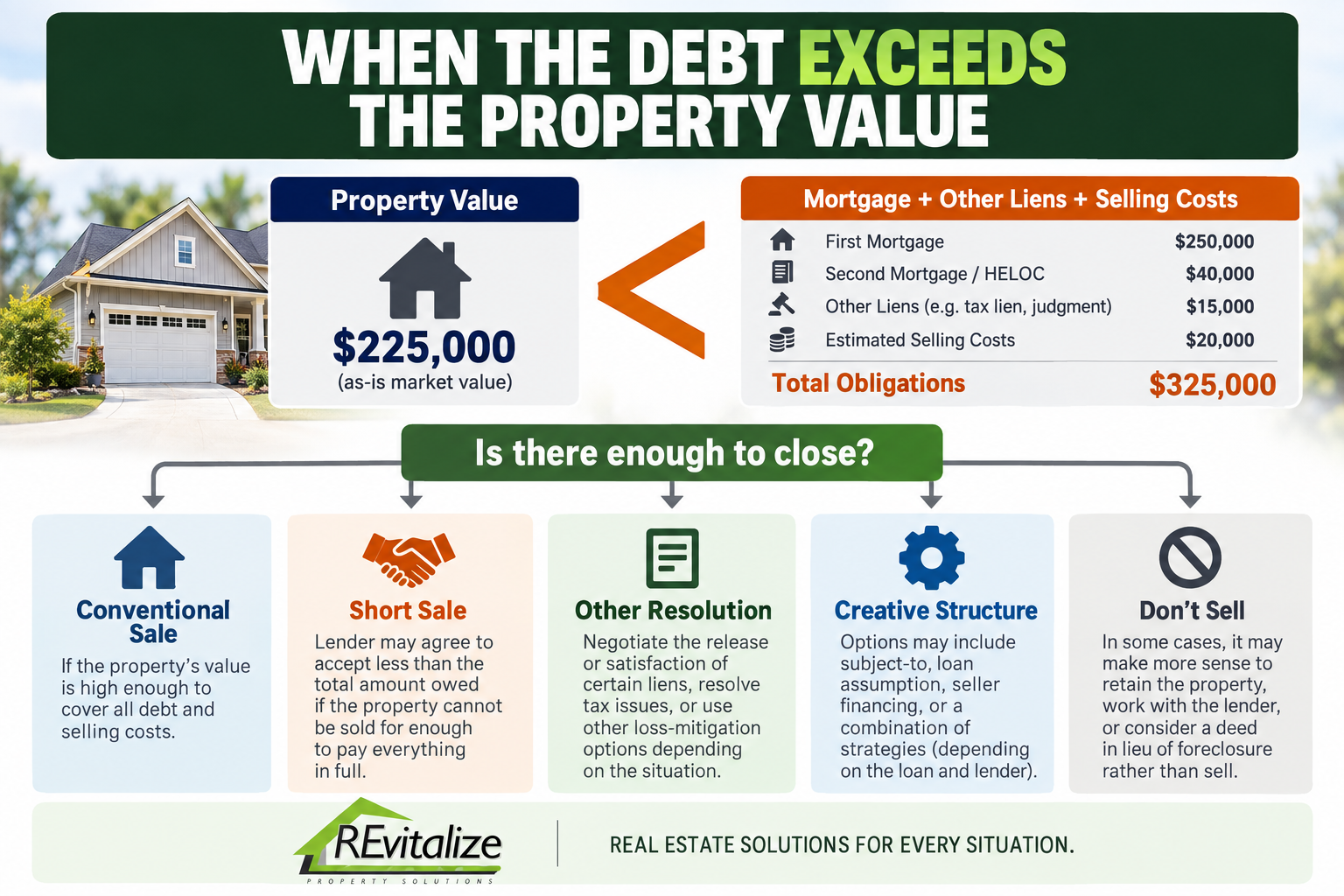
Suppose a property has an as-is market value of approximately $225,000. The mortgage payoff is $250,000, and additional obligations affecting title total another $15,000.
Even before considering transaction expenses, there isn’t enough money in a conventional $225,000 sale to pay everything in full.
That doesn’t necessarily make a sale impossible.
Depending on the circumstances, possible solutions might include bringing money to closing, obtaining approval for a short sale, negotiating the release or satisfaction of certain liens, using an appropriate alternative transaction structure, or deciding that selling the property isn’t the best option.
Which solutions are actually available depends heavily on what kind of debt is involved and what must be resolved for that particular transaction.
A Traditional Mortgage Short Sale May Be an Option
When a property cannot be sold for enough to satisfy its mortgage, the mortgage holder may, in some circumstances, approve a short sale.
A short sale generally involves the lender or mortgage investor agreeing to accept sale proceeds that are less than the amount owed so the property can be sold.
That does not mean an owner can simply accept any low offer and require the lender to take the loss.
The lender or servicer normally has its own approval process and will evaluate the proposed transaction. Requirements vary by loan type, investor, servicer, borrower circumstances, and applicable loss-mitigation program.
For example, Fannie Mae describes a short sale as selling the property at market value for less than the remaining mortgage balance, with Fannie Mae agreeing to accept the proceeds to satisfy the mortgage debt. Depending on the circumstances, a borrower may be required to make a financial contribution, but Fannie Mae states that after successful completion of its short-sale process, the borrower is relieved of responsibility for the remaining balance.
Other loans and investors may operate under different rules.
An owner considering a short sale should therefore work directly with the mortgage servicer and appropriate real estate, title, legal, and tax professionals rather than assuming that one lender’s rules apply to every loan.
Reverse Mortgages Work Differently
Reverse mortgages deserve separate discussion because the resolution process can be quite different from that of a traditional mortgage.
For federally insured Home Equity Conversion Mortgages (HECMs), the loan generally becomes due and payable after the death of the last surviving borrower, subject to protections and rules that may apply in certain circumstances, including those involving an eligible non-borrowing spouse.
HECMs also have an important non-recourse feature.
When resolving a HECM after the borrower’s death, the estate or other party with legal title may have several possible paths depending on the circumstances. Those can include satisfying the loan, selling the property, or potentially providing a deed in lieu of foreclosure.
HUD’s HECM rules specifically address situations in which the loan balance exceeds the property’s value. After the last surviving borrower dies, the estate or heirs may generally sell the property for the lesser of the outstanding HECM balance or 95% of the property’s current appraised value, subject to HUD and servicer requirements.
That distinction can be significant.
Imagine a property with a $400,000 reverse-mortgage balance that is now appraised at only $250,000. The fact that $400,000 is owed does not make the property worth $400,000.
There may be a HECM-compliant way to sell or otherwise resolve the property without the estate producing the entire difference between the debt and the property’s value.
However, these rules are specific to FHA-insured HECMs. Other reverse-mortgage products can have different terms, so the actual loan documents and servicer requirements matter.
What Happens When the Property Was Inherited?
Debt problems can become more complicated when the property owner has died.
Before focusing exclusively on how to sell the house, the family may first need to determine who owns the property and who has legal authority to act for it.
In Louisiana, that can involve the succession process.
Louisiana law establishes specific procedures for a succession representative to list or sell property being administered through a succession.
Someone being named in a will or expecting to inherit a house should not automatically assume that they already have legal authority to list or sell the property.
This becomes especially important when the property also has a reverse mortgage or other secured debt because the estate may simultaneously be dealing with ownership questions, lender requirements, property condition, and a lack of equity.
A Louisiana succession attorney can determine what needs to happen in a particular estate.
Other Liens and Debts Can Complicate the Sale
Sometimes the first mortgage isn’t the problem.
A property may have enough value to pay off the primary mortgage but still have other title issues that prevent an ordinary closing.
Suppose a property could sell for $200,000 and has a $130,000 first mortgage. At first glance, there appears to be $70,000 in gross equity.
But if a title examination reveals a second mortgage, HELOC, liens or back taxes, a judgment, or another obligation affecting the property, the owner’s actual position may look very different.
This is one reason a preliminary title examination can be valuable when there are known financial or ownership complications.
The important point is that not all debt is treated the same way. Whether an obligation must be paid in full, can be negotiated, can be released from the property, can remain in place, or follows some other process is a legal and title question.
Solving One Debt Doesn’t Necessarily Solve the Entire Problem
Properties with multiple financial or title issues need to be evaluated as a whole.
A lender approving a short sale of its mortgage does not necessarily resolve an unrelated lien against the property.
A negotiated release of one lien doesn’t eliminate a different mortgage.
Likewise, a creative transaction that allows an existing mortgage to remain in place doesn’t automatically resolve other liens or title problems.
This is why there often isn’t a single document or phone call that fixes an underwater property.
Each obligation may have its own rules, decision-maker, and resolution process. The transaction has to work as a whole before clear title can be transferred.
Bringing Money to Closing Is Sometimes an Option
If the gap is relatively small, an owner may decide to bring money to closing.
Suppose an owner needs another $5,000 to complete a sale. Paying that amount might make sense if it allows the owner to dispose of a burdensome property and move forward.
But the calculation becomes very different if the shortfall is $50,000 or $100,000.
The fact that someone can bring money to closing doesn’t necessarily mean doing so makes financial sense.
Owners should consider the size of the shortfall, their financial circumstances, the cost of continuing to own the property, any applicable deadlines, potential legal or tax consequences, and what alternatives are actually available.
Could a Creative Real Estate Structure Provide Another Option?
A conventional sale isn’t the only way a real estate transaction can be structured.
Depending on the existing financing, amount and type of debt, property value, seller’s objectives, and buyer’s strategy, an experienced investor may be able to structure a transaction differently.
One example is a subject-to acquisition. In a subject-to transaction, ownership of the property transfers to the buyer while the existing mortgage generally remains in the seller’s name. The buyer agrees to make the payments on that loan rather than paying it off at closing.
This can sometimes change the economics of a transaction because the existing mortgage may not have to be satisfied from the sale proceeds at closing.
However, the seller may remain legally responsible for the loan, and the mortgage may contain a due-on-sale clause that permits the lender to accelerate the debt following certain transfers.
Another possibility with some loans is a formal loan assumption. If the mortgage is assumable and the buyer qualifies under the applicable requirements, the buyer may be able to formally assume the existing financing. This differs from buying subject to the mortgage because the lender or servicer participates in the assumption process.
Other transactions might involve seller financing, wraparound financing, or a combination of different strategies. An experienced creative-finance investor may sometimes combine existing financing, cash, seller financing, or negotiated resolutions of other obligations to create a structure that would not be possible through a conventional sale.
But creative financing does not make debt or liens disappear.
Every mortgage, lien, judgment, or other obligation affecting the property still needs to be evaluated to determine whether it must be paid or released, can remain in place under the proposed structure, or otherwise prevents the transaction from closing.
Creative transactions can also introduce risks that are very different from those involved in an ordinary cash sale. Due-on-sale provisions, continuing borrower liability, insurance, taxes, loan servicing, title issues, documentation, and the buyer’s ability to perform over time can all become important considerations.
Some situations may involve specialized creative-finance strategies that fall outside our area of expertise. In those cases, the appropriate approach may be to involve an investor who specializes in that particular strategy, along with a qualified real estate attorney, title professional, lender or servicer, tax professional, or other appropriate professional.
Time Can Affect Which Options Are Available
Complicated property situations shouldn’t automatically be treated as emergencies, but they also shouldn’t be allowed to drift indefinitely without determining whether deadlines exist.
A pending foreclosure, delinquent property taxes, a reverse mortgage that has become due and payable, lender correspondence, succession issues, or other circumstances can create deadlines or affect the options available.
The important first step is to determine whether there is a deadline and who controls it.
If a mortgage servicer has sent notices, those notices should be reviewed rather than ignored. If the owner has died, the family may need legal guidance regarding the succession and authority to act. If foreclosure proceedings have begun, legal advice may be necessary.
The earlier the actual situation is understood, the more time the property owner or family may have to evaluate available options instead of making a decision under unnecessary pressure.
Sometimes Selling the Property Isn’t the Only Choice
When a property has little or no equity, the natural instinct may be to find some way to force a sale.
But selling isn’t always the only option.
Depending on the loan and circumstances, alternatives might include retaining the property, working with the mortgage servicer on available loss-mitigation options, pursuing a deed in lieu of foreclosure, or allowing the lender to exercise its contractual and legal remedies.
With an inherited property carrying a reverse mortgage substantially greater than its value, the heirs may also need to decide whether taking ownership of or administering the property is worth the cost and effort involved.
Sometimes the economically rational decision may be different from the emotional instinct to preserve or take ownership of a family property.
Those decisions can have legal, financial, tax, credit, and estate consequences, so they should be evaluated with the appropriate professionals rather than based solely on the property’s potential sale price.
How to Evaluate Your Options Before Making a Decision
When the debt appears to exceed the value of a property, making decisions from incomplete information can create additional problems.
Before deciding how to proceed, try to establish:
- A realistic current as-is market value
- The current mortgage payoff rather than simply the principal balance shown on a statement
- Any additional mortgages, HELOCs, liens, judgments, taxes, or other title issues
- Likely transaction expenses and estimated net proceeds
- The property’s physical condition and major repair needs
- Who owns the property and who has legal authority to sell it
- Whether the mortgage servicer offers a short-sale or other applicable resolution process
- Whether an alternative or creative transaction structure is realistically available
- Any deadlines that could affect the available options
- The likely costs of continuing to own the property while the situation is resolved
Once those pieces are known, the available options usually become much clearer.
The Bottom Line
A property doesn’t become worth more simply because the owner owes more.
When mortgages and other obligations exceed a property’s current value, an ordinary sale in which every debt and transaction expense is paid from the proceeds may not work. But that doesn’t necessarily mean the property can never be sold.
The owner may have arrived at that position because the property deteriorated, additional debt was placed against it, a reverse-mortgage balance grew over time, market values changed, or several of those things happened together.
Depending on the circumstances, a solution might involve a short sale, a reverse-mortgage resolution process, negotiation of other liens, bringing funds to closing, a properly structured creative-finance transaction, or another alternative entirely.
And sometimes, after all the options are evaluated, selling the property may not be the most practical choice.
The key is figuring out what the property is realistically worth, what actually has to be resolved, what deadlines exist, and which options are available for that particular situation.
Dealing With a Property Where the Numbers Don’t Seem to Work?
REvitalize Property Solutions works with property owners throughout the Greater New Orleans area who are dealing with complicated real estate situations, including properties needing substantial repairs, inherited houses, mortgage problems, and other circumstances where a conventional sale may not be straightforward.
We can help evaluate the property and explore potential real estate solutions based on the circumstances.
Not every problem can or should be solved by simply making a cash offer. When a situation requires legal, tax, title, lending, or other specialized advice, we’ll tell you when it needs to be handled by the appropriate professional.

